NVIDIA pushes local AI agents: What OpenClaw on RTX systems strategically changes for Europe and Switzerland

With an official RTX setup guide for OpenClaw, NVIDIA is positioning a new deployment model for AI: local, actionable agents on end devices instead of exclusively cloud-based assistants. For companies in Europe and Switzerland, this is technologically attractive, but shifts the focus from model access to governance, security and operational control.
Local AI agents become an infrastructure issue
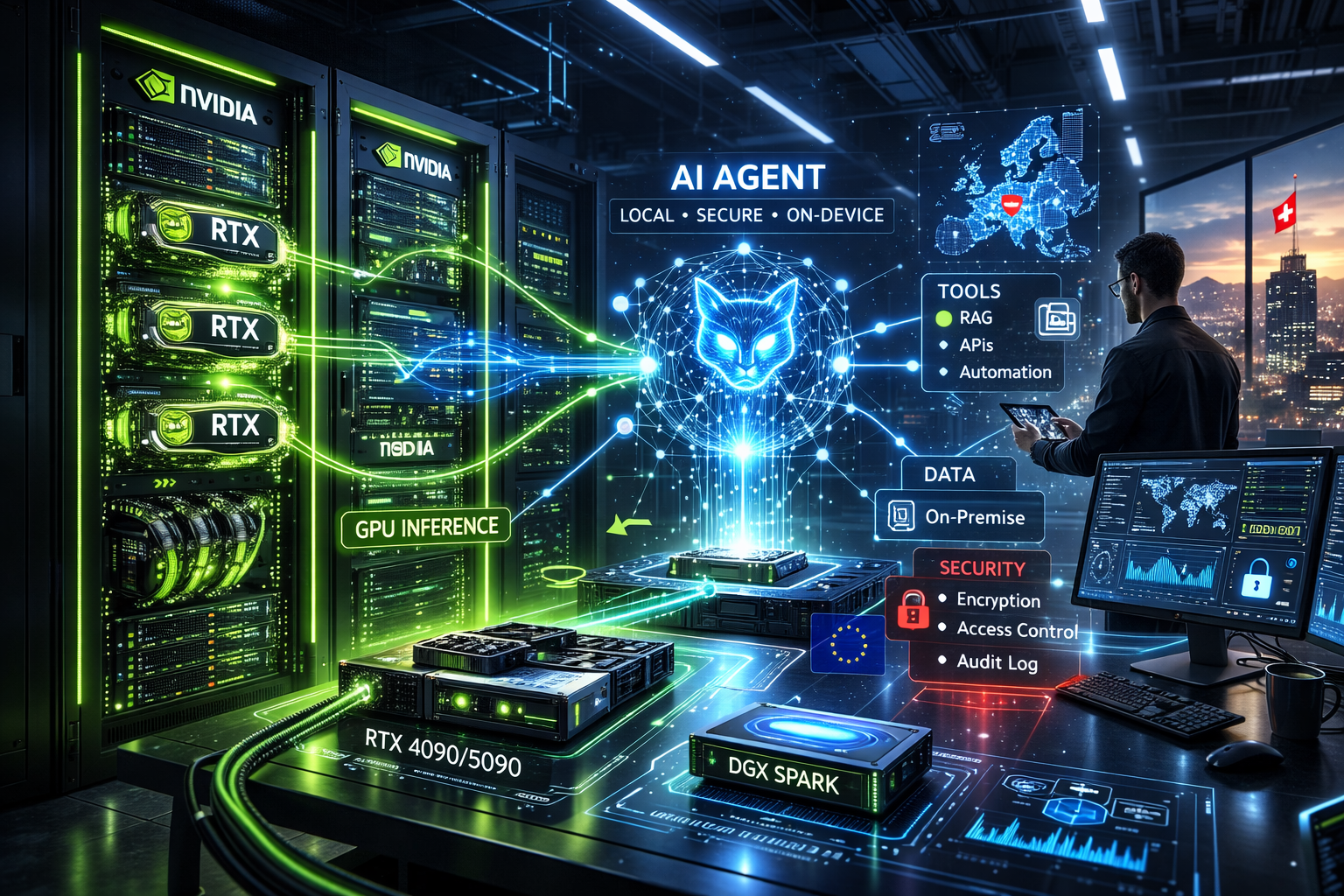
With official support for running OpenClaw on NVIDIA RTX systems, the debate surrounding artificial intelligence is shifting from pure model performance to the operational embedding of agents in real working environments. The strategic point is not only that a powerful assistant can run locally, but that a system agent can coordinate tasks across files, communication channels, and tools without sensitive data flowing into external cloud workflows by default.
This creates a relevant counter-model for Europe to the dominant platform approach of large US cloud providers: more control at the edge (edge/endpoint), combined with GPU-accelerated inference on PCs and workstations. For companies in regulated environments, this is not a minor detail, but a potential architectural change.
OpenClaw itself represents a new class of "personalized" or system-close agents that not only respond but also act. NVIDIA is significantly lowering the barrier to entry for this category with a concrete setup path for RTX GPUs and DGX Spark.

Strategic context
The background is a twofold development: First, local AI stacks are maturing (GPU acceleration, more efficient models, local runtime environments). Second, there is growing pressure in Europe to systematically incorporate data sovereignty, traceability, and regulatory connectivity into AI projects. This combination makes a local agent such as OpenClaw more strategically interesting than it was just a few months ago.
Market trend 2026: From model selection to operating model
The latest developments in the AI market show that the level of competition is broadening. It is not only model quality, but also operating model, integration speed, and security design that determine productive value. Local agents represent a trend that will become visible in 2026: hybrid stacks with local inference for sensitive tasks and cloud AI for scaling-intensive or collaborative processes.
Relevance for Switzerland
This topic is particularly interesting for Switzerland because the country is strongly characterized by SMEs, specialized service providers, and regulated industries. Many organizations are looking for AI benefits without immediately transferring sensitive data streams to foreign platforms. Local or hybrid agents can be a practical intermediate model here.

Subscribe to our newsletter
Analyses of local AI infrastructure and agentic systems delivered directly to your inbox.
Subscribe nowdata_usageHard Data & Figures
Hier sind 5 wichtige Fakten, die aus dem Text extrahiert wurden:
**NVIDIA unterstützt OpenClaw**: NVIDIA fördert die Ausführung von OpenClaw auf ihren RTX-Systemen in Europa und der Schweiz.
**Schwerpunkt verlagert sich auf Agenten**: Die Debatte um künstliche Intelligenz (KI) wird nicht mehr nur auf Modellleistung, sondern auf die operative Einbettung von KI-Agenten in reale Arbeitsumgebungen fokussiert.
**Lokale KI-Agenten erhöhen die Kontrolle**: Durch die lokale Ausführung von KI-Agenten können sensible Daten nicht standardmäßig in externe Cloud-Workflows fließen, was mehr Kontrolle am Netzrand (Edge/Endpoint) bietet.
**Gegenmodell zum dominanten Plattformansatz**: Diese Lösung bietet ein relevantes Gegenmodell zu den großen US-Cloudanbietern, indem sie die GPU-beschleunigte Inferenz auf PCs kombiniert.
Verpassen Sie keine Analyse.
Erhalten Sie wöchentlich das Wichtigste aus der Schweizer Tech-Szene und globale Insights.